The Integrated Dara Insurance Eligibility Agent
The Dara Eligibility Agent fixes one of the most persistent problems in healthcare operations: inaccurate and delayed insurance eligibility verification before billing.
Dara is DocGo’s comprehensive SaaS platform for medical transport ordering and management. In 2025, the platform facilitated more than 300,000 medical transportation requests – and processed over 10,000 eligibility verifications every week. Without the Eligibility Agent, verifying a patient’s insurance information is a manual process, and the average time from when the transport request is created with the patient’s insurance information to verified pre-billing status extend to more than 10 hours. The Eligibility Agent has the potential to reduce that timeline to under one hour with up to 70 percent automation, with humans involved only for edge cases that genuinely require judgment.
The 10-Hour Bottleneck
At this scale, even small errors create significant operational inefficiency.
On average, manual processes can result in more than 10 hours of delay from the first entry of payer information to verified pre-billing status. Delays, back-and-forth, and poor user experience meant eligibility data was rarely available in real time, regardless of whether a claim was billed to a facility, an insurer, or the patient.
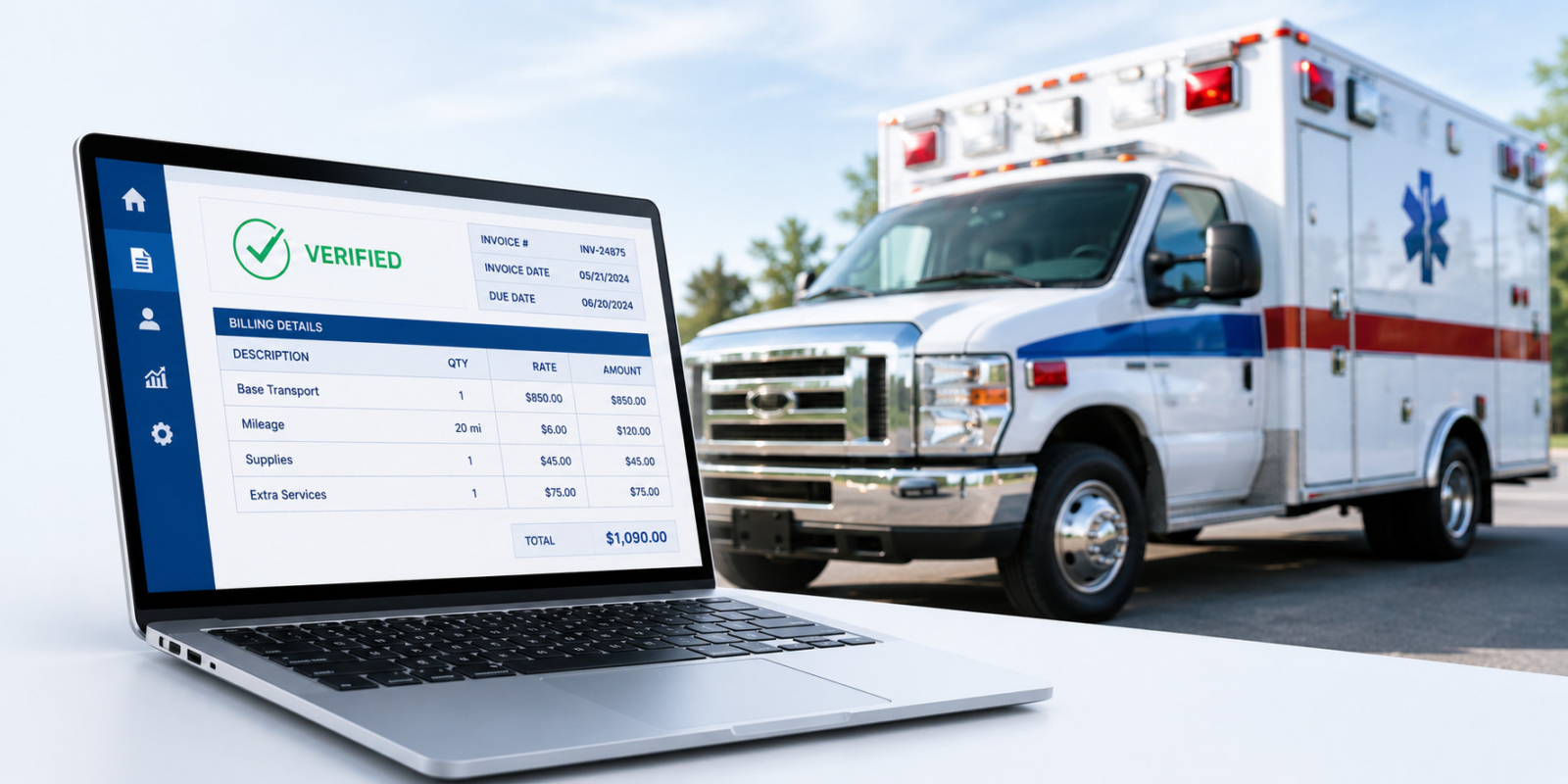
Without an integrated eligibility agent specifically designed for medical transport billing, users have to trigger checks for each trip in either third-party eligibility platforms or through individual insurance portals – and wait 30–60 seconds for a response, even when coverage was active and information appeared correct. Many requests contained incomplete or inaccurate payer data, such as missing middle initials, incorrect last names, or the wrong payer altogether. When eligibility failed, staff have to manually investigate using member IDs to identify the correct coverage – creating a loop that is repetitive, unscalable, and heavily dependent on human intervention.
Additionally, for regional or national medical transportation provides who operate across multiple markets, each market or local operations tend to have similar workflows but slightly different manual processes and nuances between the region’s most prominent health insurance payers. This inconsistency makes it difficult to replicate best practices and results in uneven quality across regions.
The result is a high error rate, rejected claims, missed collections, and higher administrative costs driven by rework, follow-up calls, and letters.
What the Eligibility Agent Does
With Eligibility Agent, by the time that a trip is fully created in Dara, eligibility and payer information should already be validated so billing teams know exactly how the service will be paid for before transport occurs. When the hospital case manager or nurse confirms the trip and receives their transport ETA, the Eligibility Agent is already at work behind the scenes automatically verifying benefits, payer details, and coordination of benefits at the start of the workflow so downstream billing is faster, cleaner, and more reliable.
The Eligibility Agent validates and corrects payer information at the point of request before the transport is passed to the provider for transport resource assignment and ultimately billing. Unique payer and market-specific rules can be easily created by billing or operations leadership in a self-service, flexible, and business-driven way, allowing workflows to adapt without brittle, hard-coded logic or delays waiting for configuration or development.
At its core, the Eligibility Agent functions as a pre-billing automation layer that hunts for inaccuracies, applies payer-specific rules, and packages clean, verified data for billing and compliance teams.
How Eligibility Worked Before
A manual pre-bill workflow looks like this:
- A trip request is created
- Hours later, pre-bill staff manually checks trip details for inaccuracies and runs eligibility checks through a third-party, non-integrated platform or directly through each health plan’s portals
- Billing teams interpret eligibility responses, determine primary and secondary payers, and validate coordination of benefits
- Notes are created for the downstream billing team and the trip is marked ready for billing
This process relied heavily on institutional knowledge and manual interpretation.
How the Eligibility Agent Changes the Workflow
With the Eligibility Agent, eligibility checks are initiated seconds after a transportation request is created.
Pre-processing rules automatically clean data, apply payer logic, and generate an eligibility report. Errors are resolved automatically where possible and only escalated for human intervention when needed.
The system includes:
- An agent embedded in the Dara web requester experience
- A data-cleaning agent that standardizes and corrects inputs
- An integration that searches an extensive payer database in seconds
- An interpreter agent that evaluates eligibility status and coordination of benefits
Together, these components automate the most time-consuming parts of insurance eligibility verification while preserving human oversight.
A Real-World Example: Catching the "Hidden" Payer
In one case, a requester entered a payer that represented only part of the patient’s coverage.
The Eligibility Agent triggered automatically and surfaced proposed changes. It identified that while Empire Blue Cross Blue Shield of New York was the primary payer, Medicare Part B (New York – Empire) was required as a secondary payer to process the claim correctly.
The agent captured the correct policy numbers and updated the payer hierarchy immediately.
Before this system, resolving this issue with the coordination of benefits required deep institutional knowledge or would have been caught weeks later in billing, often as a rejected claim. That delay impacts transport providers who are not paid on time and health systems that carry unresolved balances that may ultimately become facility or patient responsibility.
Closing the Knowledge Gap
Payer complexity still requires human judgment in some cases but the Eligibility Agent fills a critical knowledge gap – handling the majority of the claims eligibility and allowing pre-bill experts to focus solely on those trips that need human adjudication.
By analyzing policy number patterns, payer rules, and historical data, the system can:
- Submit claims to the correct payer
- Identify missing or new payers in a network
- Detect errors in name and date of birth
- Ensure primary and secondary payers are ordered correctly
- Identify when prior authorization or preauthorization is required
By resolving these issues early, Dara users can achieve greater certainty, cleaner billing, and a system designed to scale across markets without sacrificing accuracy. Reducing average time to pre-bill builds trust with billing teams, health systems, and requesters and creates a foundation for future innovation, including intelligent agents and configurable rule design. In short, the Eligibility Agent results in more accurate billing and drives greater transportation revenues by maximizing billing efficiency for cost control and great scalability.